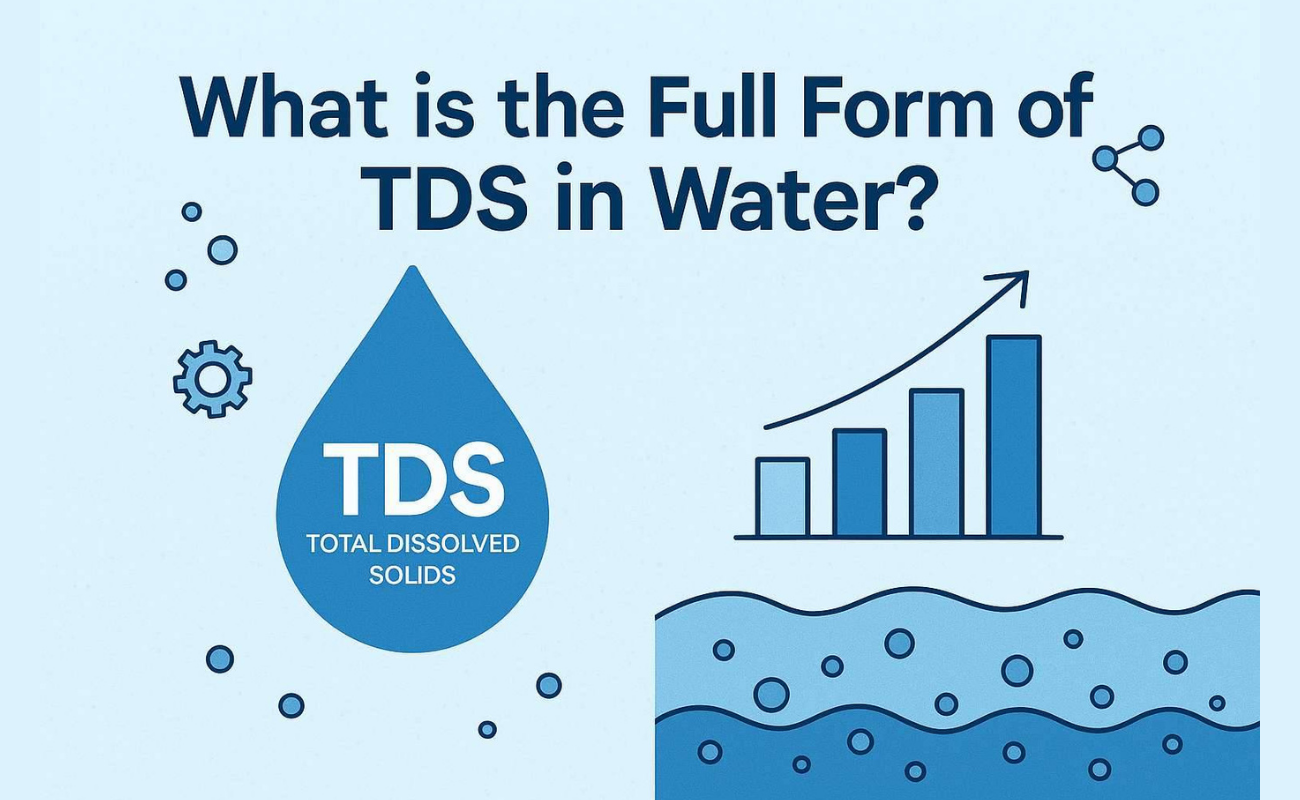
Let us just get this out of the way first. TDS full form in water is Total Dissolved Solids. That is the official name. But honestly? You can just think of it as “total dissolved stuff.” Because that is exactly what it is.
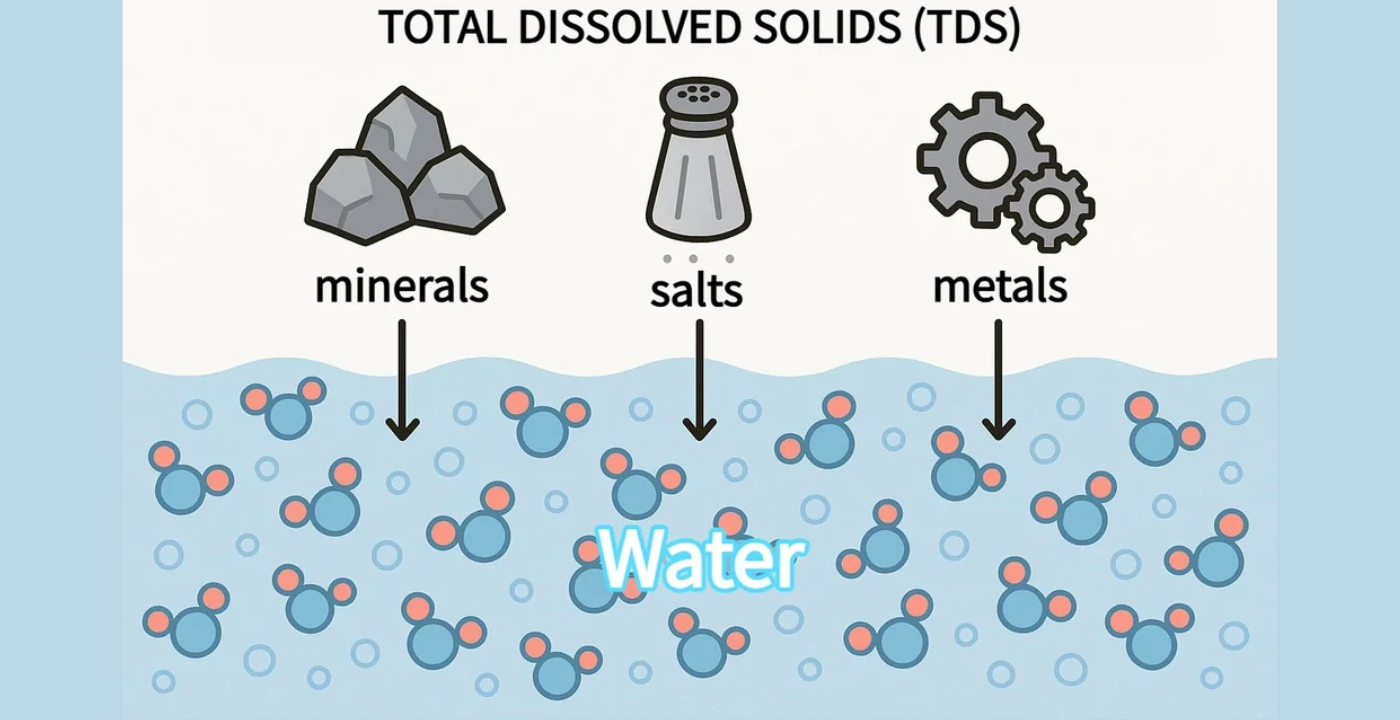
When you look at a glass of water, it looks clear, right? You think, okay, this is clean. But if you could zoom in super close, you would see tiny particles of minerals, salts, metals, and other things mixed into that water. Those particles are so small that you cannot see them. They do not float on top. They do not sink to the bottom. They are dissolved. And when you add all of them up, you get the TDS number.
So your water might have calcium in it. It might have magnesium, sodium, potassium, chloride, sulfates, nitrates, or even tiny bits of things like copper and lead. Some of those are good for you. Some are not. But the TDS number just tells you the total amount. It does not judge. It just counts everything.
Water is weirdly good at picking things up. It flows through rocks, soil, old pipes, treatment plants, and everywhere else. Along the way it grabs whatever it touches. That is why water in different cities, different neighborhoods, even different borewells in the same area, can have completely different TDS levels.
Why Should You Even Bother Knowing This?
Look, most people do not care about TDS. They see clear water and they drink it. Their logic is simple. If it looks fine and smells fine, it is fine. But here is the thing. TDS actually matters for three things that affect you every single day.
First, taste. Have you ever drunk water that tasted flat? Like you were drinking liquid nothing? That is probably because the TDS was super low. The water had basically no minerals in it. On the other side, have you ever had water that tasted salty, metallic, or just off? That is high TDS. And if you cook with high TDS water, your food tastes weird too. Rice, dal, tea, everything gets affected.
Second, your health. Some dissolved solids are actually minerals your body needs. Calcium and magnesium are not bad. They are good for you. But when TDS gets too high, you start getting things you do not want. Nitrates from fertilizers. Arsenic from certain rocks. Lead from old pipes. That is when it becomes a health problem.
Third, your house. High TDS water, especially the kind loaded with calcium and magnesium, creates that white chalky stuff you see on your kettle, your geyser, your taps. That is called scaling. It builds up slowly and then one day your geyser stops working or your pipes get clogged. So yeah, TDS is not just a number. It is a number that costs you money if you ignore it.
Read Also: Airtel Payment Bank IFSC Code: Everything You Need to Know
How Do You Even Measure TDS?
It is actually super easy. TDS is measured in ppm, which means parts per million. You might also see mg/L, which means milligrams per liter. They are basically the same thing. If your water has 250 ppm TDS, that means 250 parts out of every million parts of water are dissolved solids. That is it.
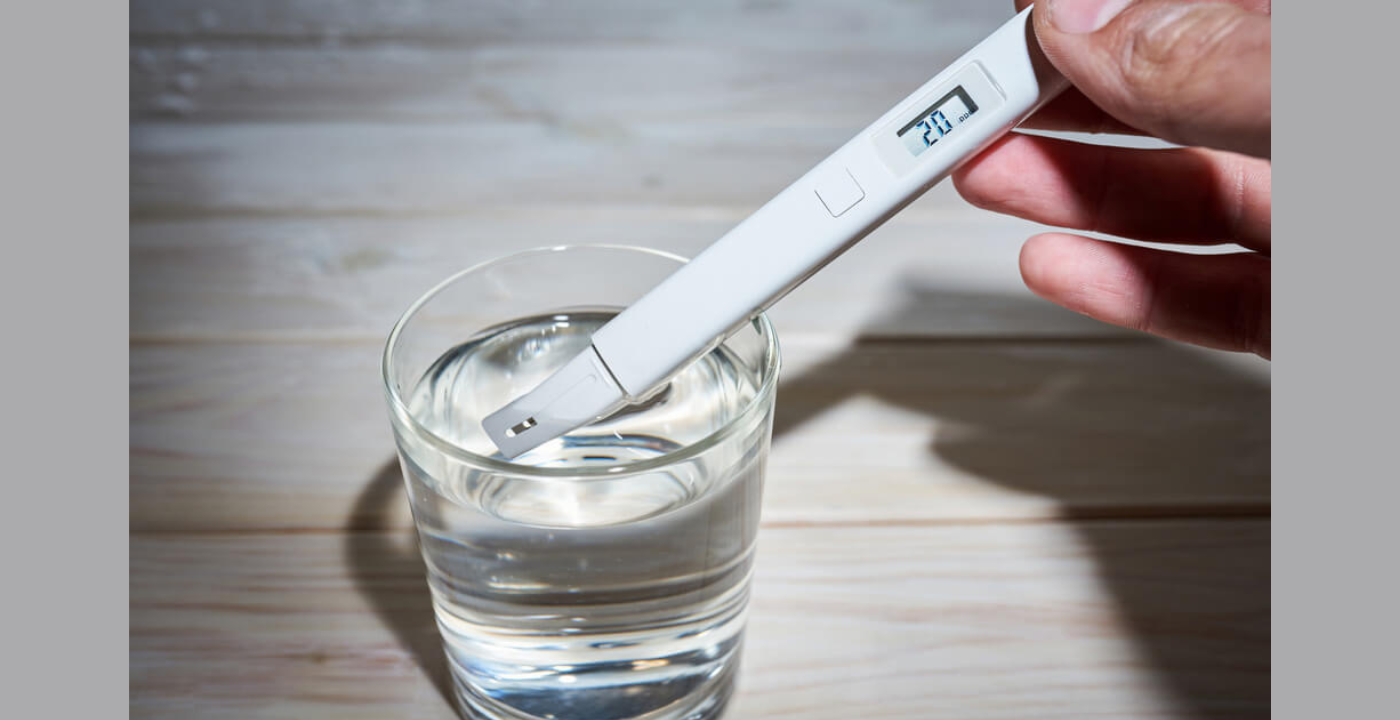
The easiest way to check this at home is to buy a TDS meter. It looks like a small pen. You dip the end into a glass of water and the number shows up on a tiny screen. These things cost like two hundred to five hundred rupees online. Everyone should have one, honestly. It takes two seconds.
But here is the catch. And this is important. A TDS meter only gives you the total number. It does not tell you what is actually in there. Your water could have 300 ppm of healthy calcium and magnesium. Or it could have 300 ppm of nasty chemicals from factory waste. The meter sees both the same way. So if your number is high, do not panic immediately. But do get a proper water test to find out what exactly is dissolved in there.
What Is a Safe TDS Level Anyway?
This is where everyone starts googling and gets confused because different organizations say different things.
The World Health Organization says anything below 300 ppm is excellent. Between 300 and 600 is good. Between 600 and 900 is fair. Between 900 and 1200 is poor. And above 1200 is basically undrinkable.
Then you have BIS, the Bureau of Indian Standards. They say 50 to 150 ppm is excellent. 150 to 300 is good. 300 to 500 is acceptable. 500 to 1000 is poor. And above 1000 is unsafe.
So who is right? Well, both of them. The general sweet spot most people agree on is between 50 and 300 ppm. That range gives you water that tastes good, has enough minerals to be healthy, but is not overloaded with junk.
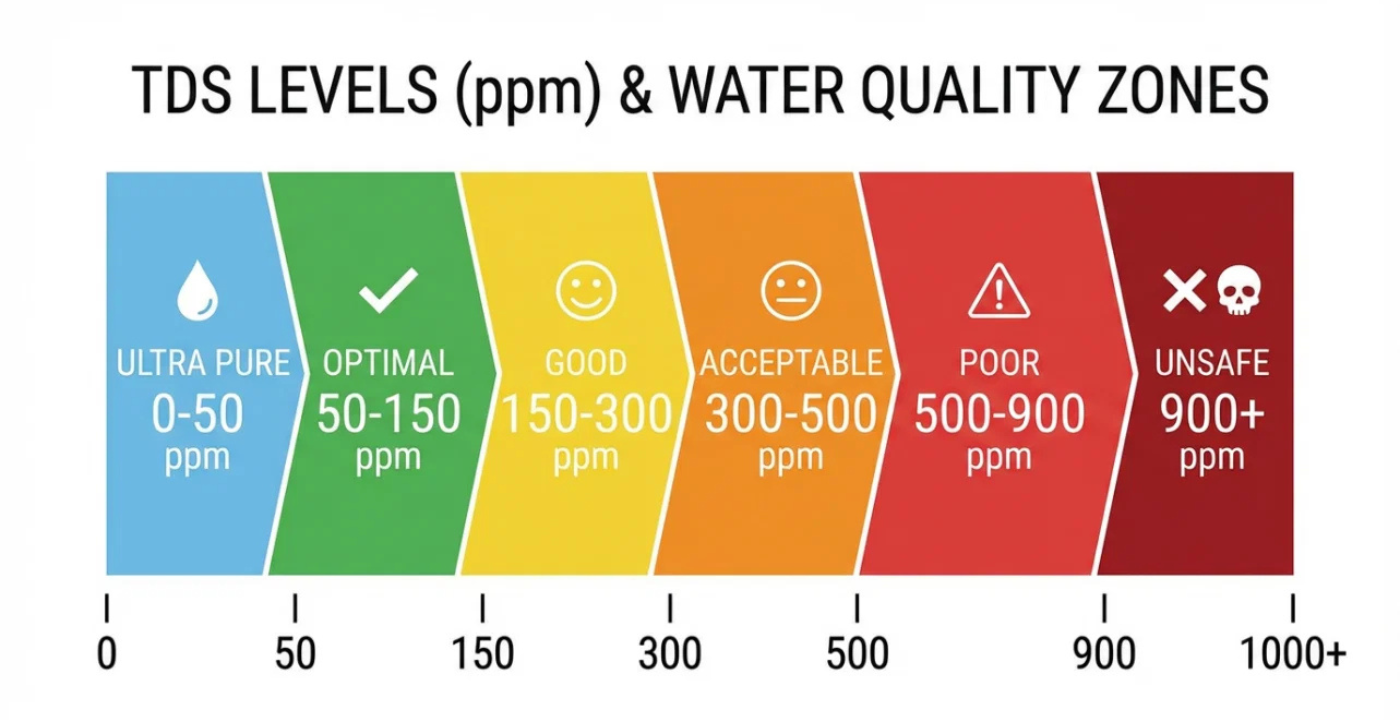
If your TDS is below 50 ppm, that is actually bad. I know it sounds weird. Lower should be better, right? But no. Water that pure is basically dead water. It has no minerals. It tastes like nothing. And if you drink it for years, your body misses out on minerals it should be getting from water. A lot of RO purifiers make this mistake. They strip everything out and give you water that is too pure. That is not good for you.
If your TDS is above 500 ppm, you are entering risky territory. The water might start tasting salty or bitter. Above 1000 ppm? Do not drink it. Just do not. That is not safe without serious treatment.
Where Does All This TDS Come From?
It does not just appear out of thin air. There are two main sources. Nature and us.
Nature does its thing when rainwater flows through rocks and soil. If you live in an area with a lot of limestone or salt deposits, your groundwater naturally picks up minerals and the TDS goes up. If you live near the sea, sometimes saltwater mixes with freshwater and boom, your TDS shoots up.
Then there is us. Humans. Farmers use fertilizers and pesticides that seep into groundwater. Industries dump stuff they should not dump. Old plumbing in buildings releases metals like lead and copper into the water. Even the chlorine that municipal corporations add to kill germs counts as dissolved solids. So your TDS is basically a story of everything your water has touched.
In India, this varies like crazy by city. Chennai and Hyderabad often have borewell water with TDS above 500, sometimes even above 1000. Mumbai usually has lower TDS because it gets more surface water from lakes. Delhi NCR is all over the place. Some areas get municipal supply at 200 ppm. Some borewells hit 800 ppm. You really cannot guess. You have to test.
Does Boiling Water Remove TDS?
I hear this all the time. People think if they boil water, it becomes pure. Sorry, but no. Boiling kills bacteria and viruses. That part is true. But the dissolved solids? They do not go anywhere. They stay right there in the water. In fact, when some water evaporates during boiling, the same amount of solids is now in less water. So technically the TDS concentration can go up a tiny bit.
If your TDS is high, boiling will not save you. You need a purifier. Period.
How Do You Actually Reduce TDS?
The most common fix is an RO purifier. RO stands for Reverse Osmosis. It forces water through a membrane with tiny holes. The holes are so small that dissolved solids cannot pass through. Only clean water makes it to the other side. A decent RO system can drop your TDS by 80 to 95 percent.
But here is the problem no one talks about. RO can make your water too clean. Let us say your input water is 300 ppm. Your RO removes 95 percent. Now your output water is 15 ppm. That is way too low. It tastes bad. It lacks minerals. And drinking that long term is not great for your health.
That is why good RO purifiers these days come with a TDS controller or a mineral cartridge. These add back some healthy minerals after the purification. The goal is not zero TDS. The goal is balanced TDS. Something between 80 and 150 ppm is perfect for drinking.
And here is another thing. If your water already has TDS between 150 and 300 ppm, you probably do not even need an RO. A UV purifier or a UF purifier is enough. Using RO on already good water is like using a sledgehammer to kill a mosquito. It strips out good stuff for no reason. So check your TDS before you buy a purifier. Do not just buy the most expensive RO because your neighbor has one.
TDS and Hard Water Are Not the Same Thing
People mix these up all the time. So let me clear it up.
Hard water specifically means water with lots of calcium and magnesium. That is it. Just those two. And they cause scaling. White deposits on your taps. Soap not lathering properly. That stuff.
TDS is the big umbrella. It includes calcium and magnesium, sure. But it also includes sodium, chloride, potassium, nitrates, sulfates, and basically everything else dissolved in there. So all hard water has TDS. But not all high TDS water is hard water. You could have high TDS from sodium and it would not be hard water.
If your only issue is white scaling, maybe you need a water softener. If your issue is overall bad taste and high total dissolved solids, you need RO. Different problems, different solutions.
Final Word
So let us wrap this up. TDS full form in water is Total Dissolved Solids. It is just a number that tells you how much stuff is dissolved in your water. Some of that stuff is good. Some is bad. The ideal range is 50 to 300 ppm. You can check it at home with a cheap TDS meter in two seconds.
If your number is high, get an RO but make sure it has a TDS controller so you do not end up with dead water. If your number is already fine, do not waste money on RO. Use UV or UF instead. And please stop thinking boiling fixes high TDS. It does not.
At the end of the day, clean water is about balance. Not too much junk. Not too little minerals. Test your water. Know your number. Pick the right purifier. That is all you really need to do.
Read More: ATM Check: How to Check Your Bank & Salary Card Balance in UAE (2026)
[…] Read Also: TDS Full Form in Water: What It Actually Means Without the Boring Science Lecture […]